
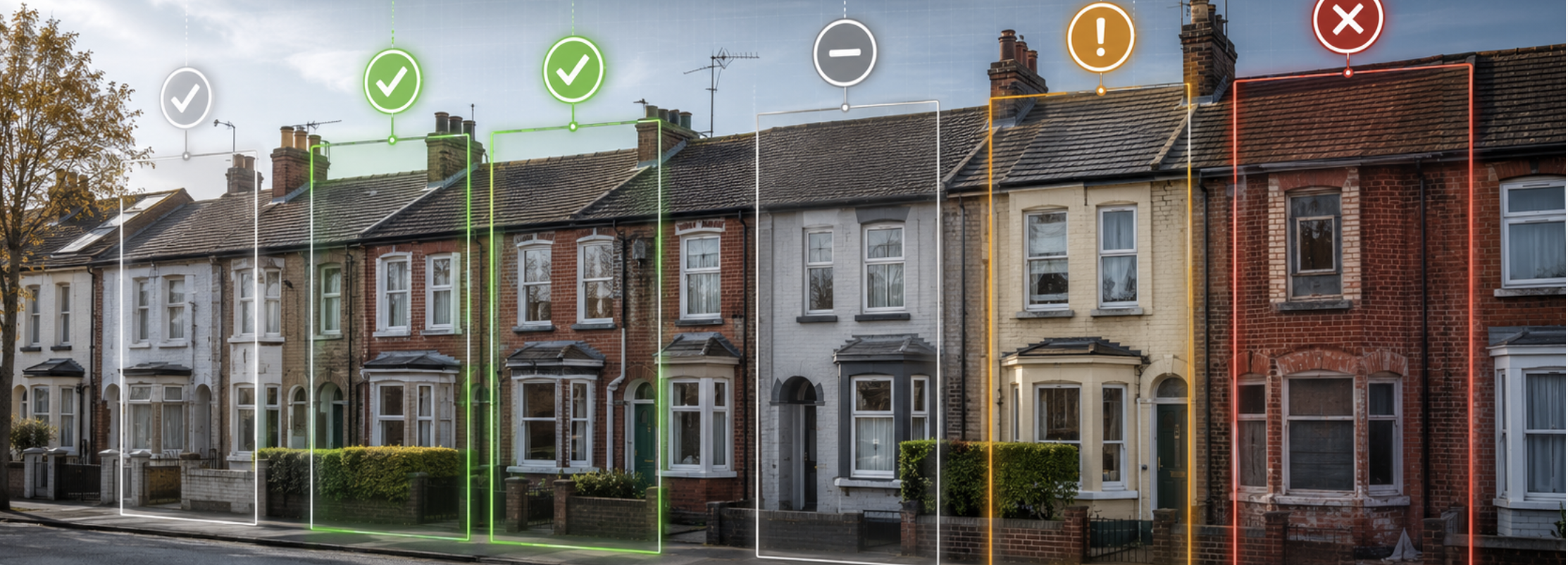
Housing associations and local authorities are under significant pressure to turn funding allocations into deliverable retrofit programmes.
They need to identify suitable homes, develop viable improvement packages, engage residents, mobilise contractors and report confidently against delivery milestones.
But how much attention is given to the quality of the data and tools used to decide whether a property should be included in the first place?
Could potentially viable homes be falling out because the modelling tool is too restricted?
Could programme forecasts be built on property lists that were never as reliable as they first appeared?
And could some of the delays and difficult milestone conversations experienced later in delivery begin much earlier, with the quality of the original stock data and the way properties are modelled?
How reliable was the original property list?
Many retrofit programmes begin with a large list of homes identified from existing stock data.
But how accurate is that starting point?
Housing data may have been collected over many years, through different systems and for different purposes. It may contain outdated EPC information, assumed construction details, incomplete records of previous improvements or inconsistencies between databases.
That can create an impression of certainty that does not always survive closer inspection.
A property may initially appear suitable because the available data suggests:
- It sits below the required EPC band
- It has a particular wall or roof type
- It has not previously received insulation
- It uses a certain heating system
- It has enough theoretical potential to achieve the programme target
But what happens when the assessment identifies something different?
What if previous work has not been recorded?
What if the construction type was assumed incorrectly?
What if the dimensions, condition or existing insulation differ from the stock record?
What if the original EPC no longer reflects the home as it currently stands?
In those circumstances, the property has not necessarily become unsuitable. The original list may simply have been built on information that was not detailed or current enough to support a firm delivery decision.
This raises an important question:
How much confidence should be placed in a programme pipeline before the underlying property data has been verified?
A large property list is not the same as a confirmed programme.
It is a longlist that still needs to be tested through assessment, modelling, technical review and resident engagement.
Are we modelling the property or the limitations of the software?
Once better information has been collected, the modelling process should help the delivery team understand what is genuinely possible.
But what happens when the software cannot accurately represent the measures being considered?
Not every home will be suitable for every retrofit programme.
Properties may fall out because of technical constraints, planning restrictions, structural condition, resident circumstances, access issues or poor value for money. That is a normal and necessary part of responsible delivery.
However, can every excluded property confidently be described as unviable?
Or are some homes being removed because the software does not provide enough flexibility to explore the proposed specification properly?
Some modelling tools offer only limited control over elements such as:
- Insulation thicknesses and thermal performance
- Heating-system assumptions
- Solar photovoltaic systems and array sizes
- Renewable technologies
- Combinations of fabric, heating and renewable measures
- Alternative packages during optioneering
Where the inputs are restricted, the resulting output will also be restricted.
If the software cannot adequately represent the work being proposed, is the result showing the realistic potential of the home?
Or is it simply showing the closest approximation the tool is capable of producing?
What happens when a property narrowly misses the target?
Properties do not always miss a required outcome by a wide margin.
A home may sit just below the desired EPC band or another programme threshold. In these cases, the quality and flexibility of the optioneering process become particularly important.
Can the user test a different insulation specification?
Can they adjust the thickness or performance of the proposed measure?
Can they model the intended solar array in sufficient detail?
Can they compare the effect of fabric improvements against heating or renewable options?
Most importantly, can they understand why the property is falling short and what realistic changes might make a difference?
A simple pass-or-fail result may be easy to interpret, but is it enough to support a significant investment decision?
Before excluding a home, should the organisation not be able to ask:
What would need to change for this property to become viable?
This does not mean altering assumptions until a favourable answer appears.
Good modelling should never be about making every property pass. It should be about representing the intended work accurately, testing credible alternatives and reaching a better-informed decision.
Could potentially viable homes be falling out too early?
Where the original property list is based on incomplete or outdated information, some fall-out is inevitable.
The problem becomes more significant when a restricted modelling tool is then unable to explore the property properly once better information becomes available.
A home may appear unable to reach the required outcome within a simplified model. With more accurate inputs, a revised package or a better representation of the proposed specification, it may produce a different result.
Where that opportunity is not explored, the organisation may need to find a replacement property.
That can mean:
- Additional resident contact
- More appointments and surveys
- Further modelling and optioneering
- More internal review
- Additional coordination work
- Greater cost
- Less time available for delivery
Across one property, the effect may appear manageable.
Across several sites or a large programme, it can materially weaken the confirmed pipeline.
How many additional homes are being assessed because potentially viable properties were excluded too quickly?
How much programme capacity is being used to replace properties that might have remained within scope under a more flexible modelling process?
And by the time those replacements are ready, how much of the delivery period has already been lost?
Are milestone problems sometimes pipeline problems?
When a retrofit programme falls behind, attention often turns to installation rates, contractor performance, resident access or supply-chain capacity.
All of these can affect delivery.
But should more attention also be given to the quality and certainty of the property pipeline?
If too many homes fall out during assessment and optioneering, the delivery team may never have had enough confirmed properties to achieve the funded volume within the required timeframe.
That can create difficult questions during milestone reporting:
- Why is the confirmed property total below forecast?
- Why are more homes still being assessed?
- When will replacement properties be identified?
- Can the funded volume still be achieved?
- Will the next milestone be met?
- Does the delivery forecast remain credible?
- Is there a risk that part of the allocation will not be utilised?
By the time these questions are being asked, the original property selection and modelling decisions may have taken place months earlier.
Would more reliable stock data and more flexible modelling prevent every property from falling out? Of course not.
Could they help organisations build a stronger and more dependable pipeline? Potentially, yes.
What should housing providers expect from a modelling tool?
A modelling tool should do more than return a projected score.
It should help users understand:
- What is technically possible
- Why the property is falling short
- Which realistic changes could affect the outcome
- How alternative packages compare
- Whether additional investment is justified
- Whether the property should remain in the programme
RetrofitOS provides an RdSAP-based modelling and optioneering environment with greater flexibility around the measures and specifications being considered.
Users can explore areas such as insulation thicknesses, performance assumptions, heating changes, solar installations, renewable technologies and alternative combinations of measures.
This is particularly valuable where a property is close to the required result.
Rather than receiving only a pass-or-fail answer, the delivery team can investigate the reasons behind the outcome and consider whether a realistic alternative package could improve it.
The purpose is not to produce the most optimistic result.
It is to ensure the decision is based on a sufficiently complete and realistic understanding of the property.
Are we measuring activity or achieving the intended outcome?
The wider purpose of public retrofit funding should not be forgotten.
The objective is not simply to assess properties, install measures and record completions.
It is to improve homes at scale.
That means reducing energy demand, improving comfort, strengthening the condition and performance of housing stock, reducing carbon emissions and giving residents greater protection from an uncertain energy market.
These outcomes cannot be assumed simply because a measure has been installed.
Should programmes focus only on whether a measure appears in the proposed package?
Or should they test how that package is expected to perform for the particular home?
Modelling is not an isolated technical exercise. It is one of the ways public investment is translated into a credible property outcome.
The question programmes should be asking
Some properties will always fall out for valid reasons.
But where delivery targets depend on maintaining a sufficiently strong pipeline, housing providers should be confident that homes are not being excluded because of poor initial data or limitations within the software used to evaluate them.
Before removing a property from a programme, organisations should be able to ask:
Can we trust the information used to select this home?
Can the tool accurately represent the specification we are considering?
Can we test realistic alternatives?
Can we understand why the property is falling short?
And ultimately:
Are we making a decision based on the true potential of the property, or on the limitations of the data and modelling software available to us?
Greater modelling detail can help answer those questions. But technical depth alone is not enough.
In Part Two, we will explore what happens when detailed modelling sits separately from the methodology used to evidence the final outcome and from the wider delivery process—forcing teams to bridge gaps between design intent, documentation, assessment and lodgement.